
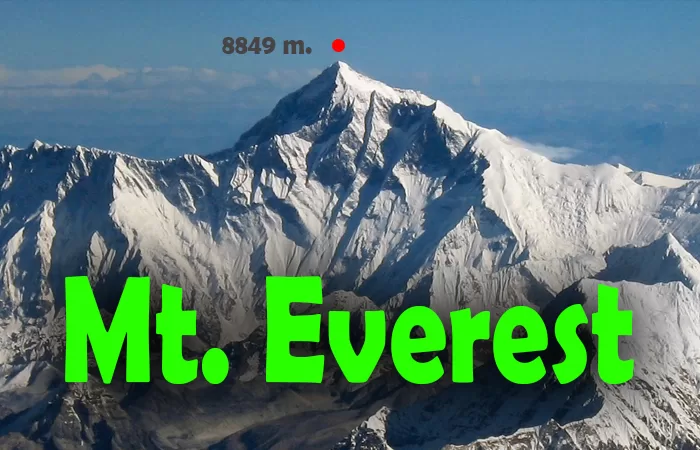
Mount Everest is the highest mountain in the world, with an elevation of 8,849 meters (29,032 feet) above sea level. It is located in the Himalayas, on the border between Nepal and China. It is a popular destination for adventurous climbers, but also a dangerous one, as many people have died trying to reach the summit.
Mount Everest was named after George Everest, a British surveyor who mapped the Indian subcontinent in the 19th century. However, the local people have their own names for the mountain, such as Sagarmatha in Nepali, meaning ‘forehead of the sky’, and Chomolungma in Tibetan, meaning ‘mother goddess of the world’.
The first successful ascent of Mount Everest was in 1953, by Edmund Hillary, a New Zealander, and Tenzing Norgay, a Sherpa guide. They reached the summit using the southeast ridge route, which is still the most common route today. They were part of a larger expedition led by John Hunt, a British army officer.
Mount Everest is not only a challenge for climbers, but also a wonder of nature. It is home to many rare and beautiful species of plants and animals, such as the snow leopard, the red panda, the Himalayan tahr, and the rhododendron. It is also part of the UNESCO World Heritage Site of the Sagarmatha National Park in Nepal and the Qomolangma National Nature Preserve in China.
Some Facts about Mount Everest that you might find interesting:
- Mount Everest is the highest point on Earth, with an elevation of 8,849 meters (29,032 feet) above sea level.
- Mount Everest was named after George Everest, a British surveyor who mapped the Indian subcontinent in the 19th century. However, the local people have their own names for the mountain, such as Sagarmatha in Nepali, meaning ‘forehead of the sky’, and Chomolungma in Tibetan, meaning ‘mother goddess of the world’.
- The first successful ascent of Mount Everest was in 1953, by Edmund Hillary, a New Zealander, and Tenzing Norgay, a Sherpa guide. They reached the summit using the southeast ridge route, which is still the most common route today.
- Mount Everest is home to many rare and beautiful species of plants and animals, such as the snow leopard, the red panda, the Himalayan tahr, and the rhododendron. It is also part of the UNESCO World Heritage Site of the Sagarmatha National Park in Nepal and the Qomolangma National Nature Preserve in China.
- Mount Everest is a challenging and dangerous mountain to climb, requiring technical skills, physical endurance, and acclimatization. The area above 8,000 meters (26,000 feet) elevation on Everest is called the ‘death zone’, where the oxygen level is very low and the risk of altitude sickness and brain swelling is high.
- Mount Everest’s climbing industry has become controversial, as popularity of the climb has increased, there have been more ‘traffic jams’ as climbers spend too much time in the death zone waiting for their chance to go to the summit.
- Mount Everest continues growing every year by at least 4 mm due to the geological uplift. It is for this reason that there are lots of contradictions and controversies surrounding the actual height of this mountain, as different surveyors have measured it multiple times.
- Mount Everest has the shape of a three-sided pyramid, with three faces and ridges. While every face is rock-hard, it mostly contains snow, with high snow levels appearing in September following the monsoon.
- Mount Everest is not the tallest mountain on earth, if measured from the base to the summit. Mauna Kea, a mountain in Hawaii, is 33,500 feet tall but only 13,796 feet of it is above sea level.
