
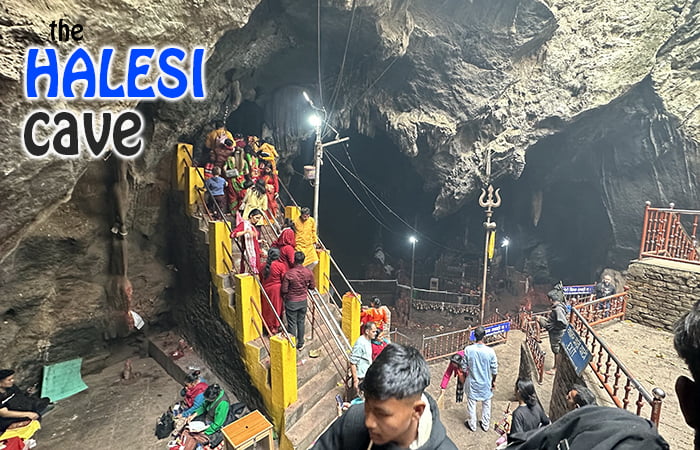
Halesi Mahadev is a sacred cave temple located in Khotang district of Nepal. It is also known as Halesi-Maratika Caves or Haleshwor Mahadev.
The cave is believed to be the abode of Lord Shiva, a form of Mahadeva, and is visited by thousands of devotees each year. The cave is also a pilgrimage site for Buddhists, who associate it with the legend of Padmasambhava, a great master of Vajrayana Buddhism. The cave is also revered by the Kirati Rai people, who worship Halesi as an ancestral deity.
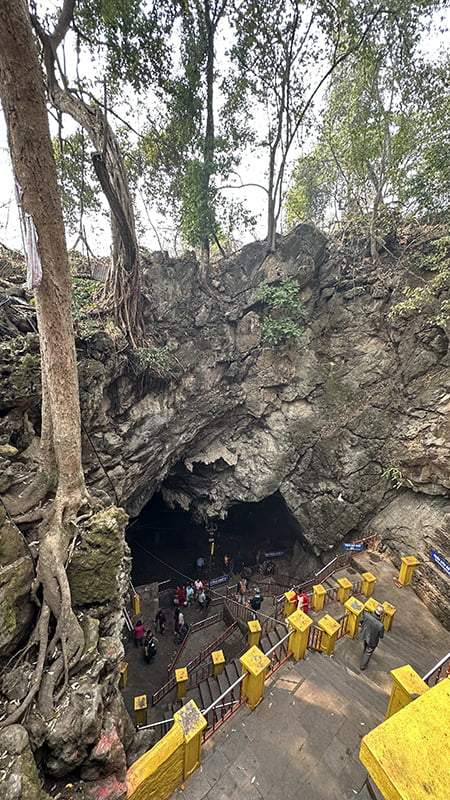
The cave is located between the holy rivers Dudhkoshi and Sunkosi, and is about 185 km southwest of Mount Everest. The cave is 67 feet below the surface and has a round shape, with a diameter of 193 feet.
The cave has several natural statues and structures, such as the sin gateway, the virtue gateway, the birth gateway, the paradise door, the karma dwar, and the statue of thirty-three koti (33 crore) gods. The cave also has a natural idol of Ganesh and a structure resembling Parvati bringing milk for Ganesh.
The Halesi Mahadev temple is an important cultural and historical site in Nepal, and attracts many tourists and pilgrims from different religions and backgrounds. The temple is also known as the Pashupatinath of the east, and is celebrated during festivals such as Shivaratri and Bala Chaturdashi. The temple is a symbol of the harmony and diversity of Nepal’s religious traditions.
000
The Halesi-Maratika Caves, also known as the Haleshi Mahadev Temple, is a venerated pilgrimage site for Hindus, Buddhists, and Kirat located in the Khotang District of eastern Nepal. The caves are naturally formed and are located at an altitude of 3,100 ft. – 4,734 ft. above sea level. The temple is nicknamed ‘the Pashupatinath of the east’ and is well-attended during religious fairs on Shivaratri and Bala Chaturdashi.
